Wednesday, 23 December 2015

#1 Question Analytical Reasoning

Find the number of triangles in the given figure?
A) 10B) 12
C) 14D) 16

 Answer & ExplanationAnswer: C) 14 

Explanation:
The figure may be labelled as shown
The simplest triangles are ABJ, ACJ, BDH, DHF, CIE and GIE i.e 6 in number.
The triangles composed of two components each are ABC, BDF, CEG, BHJ, JHK, JKI and CJI i.e 7 in number.
There is only one triangle JHI which is composed of four components.
Thus, there are 6 + 7 + 1 = 14 triangles in the given figure.

Number Series question no. #2

Number Series question no. #2

Number Series is easy as well as an important chapter. If you follow below mentioned tricks of this chapter, you can fetch marks from this chapter easily and quickly.

Q2.    62,64,______, 32, 14,16   

a) 26

b) 28

c) 30

d) 32

e) None of The Above

Solution

Option C


Number Series question no. #3

Number Series question no. #3

Number Series is easy as well as an important chapter. If you follow below mentioned tricks of this chapter, you can fetch marks from this chapter easily and quickly.

Q3.    100, 50, 52, 26, 28,______

a) 30

b) 32

c) 14

d) 16

e) None of The Above 

Solution 

Option C


Number Series question no. #4

Number Series question no. #4

Number Series is easy as well as an important chapter. If you follow below mentioned tricks of this chapter, you can fetch marks from this chapter easily and quickly.

Q4.      980, 392, 156.8,______, 25.088, 10.0352

a) 62.72

b) 63.85

c) 65.04

d) 60.28

e) None of The Above 

Solution

Option A


Number Series question no. #5

Number Series question no. #5

Number Series is easy as well as an important chapter. If you follow below mentioned tricks of this chapter, you can fetch marks from this chapter easily and quickly.

Q5.         113, 225, 449,_____, 1793

a) 789

b) 786

c) 897

d) 987

e) None of The Above 

Solution

Option C


Number Series question no. #6

Number Series question no. #6

Number Series is easy as well as an important chapter. If you follow below mentioned tricks of this chapter, you can fetch marks from this chapter easily and quickly.

Q6.        5, 9, 21, 37, 81,_____

a) 163 

b) 153

c) 181 

d) 203 

e) None of The Above

Solution 

Option B


Number Series question no. #7

Number Series question no. #7

Number Series is easy as well as an important chapter. If you follow below mentioned tricks of this chapter, you can fetch marks from this chapter easily and quickly.

Q7.     2, 10, 30, 68,______

a) 126

b) 130

c) 140

d) 150

e) None of The Above 

Solution

Option B


Number Series question no. #1

Number Series question no. #1

Number Series is easy as well as an important chapter. If you follow below mentioned tricks of this chapter, you can fetch marks from this chapter easily and quickly.

Q1.   5, 25, 7,______, 9, 19

a) 23

b) 22

c) 25

d) 32

e) None of The Above

Solution

Option B


Saturday, 19 December 2015

#3 Model of Partnership Questions

When Amount of Capital Invested is not given 

Lets take the example to understand this case.

Example 3.

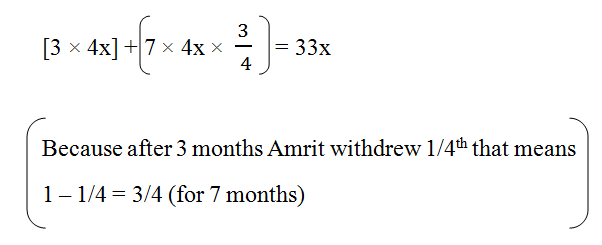
Amrit and Brij entered into partnership with capitals in the ratio of 4:5. After 3 months, Amrit withdrew 1/4th of his capital and B withdrew 1/5th of his capital. The gain at the end of 10 months was Rs. 760. Find their shares of profits.

Answer - 

As the ratio of capitals of Amrit and Brij are given 4 : 5

Let, the capitals of Amrit and Brij be 4x and 5x respectively. Hence, monthly equivalent of investment  (MEI) of Amrit

=

Similarly, monthly equivalent of investment of Brij is:

As we know:


#2 Model of Partnership Questions

If the business is run by more than Two Partners 

In such a case, following formula is applied.

MEI of A : MEI of B : MEI of C = Profit of A : Profit of B : Profit  of C

Example 2.

Ajay, Bashir and Cherman enter into a partnership. Ajay contributes Rs. 320 for 4 months, Bashir contributes Rs. 510 for 3 moths and Cherman contributes Rs. 270 for 5 months. If the total profit is Rs. 208, find the profit share of the partners.

Answer - 

MEI of Ajay : MEI of Bashir : MEI of Cherman= Ajay's profit : Bashir's Profit : Cherman's Profit  

(MEI stands for Monthly Equivalent Investment)

   = (320 × 4) : (510 ×  3) : (270 ×  5)

          = 1280 : 1530 : 1350

               = 128 : 153 :135


#1 Model of Partnership Questions

If the business is run by Two Partners 

Suppose A and B are two partners that run the business. In such a case following formula is used:

Another formula is 

(MEI stands for Monthly Equivalent Investment)

Example 1.

Akshay and Bobby together invested Rs. 12,000 in a business. At the end of the year, out of a total profit of Rs. 1800, Akshay's share was Rs. 750. What was the investment of Akshay?

Answer - 

As from the above information, profits are shared in the ratio of their investents. Money invested by A and B for the same period so, following formula will be apply.


Partnership Questions with Tricks

Partnership Questions with Tricks

Today, We sharing the 'Partnership' chapter from quantitative aptitude. It is also an important chapter because 1-2 questions in exams mostly comes from this chapter.Partnership chapter with examples is given below. I hope it will be beneficial for you.

Meaning and Introduction

Definition of 'Partnership' as per Partnership Act, 1932 

"Partnership is relation between persons who have agreed share the profits of a business carried on by all any of them acting for all."

Formulae

Following are some formulae to solve the questions based on this chapter. Learn these formulas carefully .

#4 Model of Partnership Questions

Some Other Type of Questions

Example 4.

What amount of money is divided between Ashok, Bindusara and Chandragutpa if Bindusara and Chandragupta together get Rs. 100 and Ashok gets twice as much as Bindusara while Chandragupta with Ashok gets Rs. 150?


Answer -

(For ease of the solution take Ashok,Bindusara and Chandragupta as A, B and C)

Given that

B + C = 100

A + C = 150

A = 2B

2B + C = 150

B + (B + C) = 150    [Since B + C = 100]

B = 150 - 100 = 50

A + B + C = (A + C) + B = 150 + 50 = Rs. 200

Example 5.

In a partnership, A invests 1/6 of the capital for 1/6 of the time, B invests 1/3 of the capital for 1/3 of the time and C, the rest of the capital for whole time. Find A's share of the total profit of Rs. 2300.


Answer -

Capital of C = 1 - 1/6 - 1/3 = 1/2

Let the total time be 12 months

A's profit : B's profit : C's profit = MEI of A : MEI of B : MEI of C

Share of Ashok = 1/ 23 × 2300 = Rs. 100

So, above are the some formulas to understand the 'Partnership' chapter. So, Keep the practice and All the Best.

Monday, 7 December 2015

Blood Relationship Q5th

When Anuj saw Manish, he recalled, "He is the son of the father of my daughter." Who is Manish ? 
A) Brother-in-lawB) Brother
C) CousinD) Uncle
 Answer & ExplanationAnswer: A) Brother-in-law

Explanation:
Anuj's daughter's mother — Anuj's wife ;
Anju's wife's father - Anuj's father-in-law; 
Father-in-law's son — Anuj's brother-in-law
So, Manish is Anuj's brother-in-law 

Blood Relationship Q4th

There is a family of six persons A, B, C, D, E and F. They are Lawyer, Doctor, Teacher, Salesman, Engineer and Accountant There are two married couples in the family. D, the Salesman is married to the Lady Teacher. The Doctor is married to the Lawyer. F, the Accountant is the son of B and brother of E. C, the Lawyer is the daughter-in-law of A. E is the unmarried Engineer. A is the grandmother of F. How is E related to F? 
A) BrotherB) Sister
C) CousinD) Cannot be determined


 Answer & ExplanationAnswer: D) Cannot be determined

Explanation:
C is the daughter-in-law of A who is the grandmother of F means C is the mother of F. But F is the son of B. 
So. B is C's husband. But C, the lawyer is married to the Doctor So. B is the Doctor. F, the Accountant  will be the son of B and C. E is the unmarried Engineer 
So. the other mamed couple can be that of grandmother of F i.e, A and D.  But D, the Salesman, is married to the Lady Teacher. 
So. D, the Salesman, is the grandfather of F. father of B and the husband of A, the Lady Teacher. 
Clearly, from the given data, the relation between E and F cannot be determined. 

Blood Relationships 3rd Question

Pointing out to a lady, a girl said, "She is the daughter-in-law of the grandmother of my father's only son." How is the lady related to the girl ?
A) Sister-in-lawB) Mother
C) AuntD) Can't be determined
 Answer & ExplanationAnswer: D) Can't be determined

Explanation:
Girls's father's only son— Girl's brother. Daughter in law of girl’s grandmother can be their mother, or maternal uncle’s wife, i.e. aunt. So relation cannot be determined.

Blood Relationships 2nd Question & Answer

There are six persons A. B, C, D, E and F. C is the sister of F. B is the brother of E's husband. D is the father of A and grandfather of F. There are two fathers, three brothers and a mother in the group. Who is the mother ?
A) AB) B
C) CD) E


Explanation:
D is father of A and grandfather of F. So, A is father of F. 
Thus. D and A are the two fathers. C is the sister of F So. C is the daughter of A. 
Since there is only one mother, it is evident that E is the wife of A and hence the mother of C and F. 
So, B is brother of A There are three brothers. So. F is the brother of C. 
 Clearly, A is E's Husband.

Arithmetic Series 7th Answer

7).  8, 16, 28, 44, ?

Sol(7):


Arithmetic Series 6th Answer

6). 2, 3.5, 5, 6.5, 8, ?

Sol(6):


Arithmetic Series 5th Answer

5).  24, 60, 120, 210, ?

Sol(5):


Blood Relationships Q1

A is B's sister. C is B's mother. D is C's father. E is D's mother. Then, how is A related to D?
A) GrandfatherB) Grandmother
C) DaughterD) Granddaughter


 Answer & ExplanationAnswer: D) Granddaughter

Explanation:
A is the sister of B and B is the daughter of C.
So, A is the daughter of C. Also, D is the father of C.
So, A is the granddaughter of D. 

Sunday, 6 December 2015

Arithmetic series 4th Answer

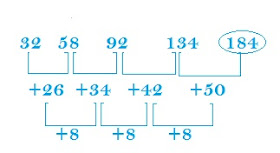
4)   32, 58, 92, 134, ?

Sol(4):


Arithmetic Series 3rd Answer

3)   3.5, 7, 10.5, 14, ?

Sol(3):


Arithmetic series 2nd Answer

2) 4, 5, 7, 10, 14, 19,  ?

Sol(2):


Arithmetic series 1st Answer

We promised you the daily basis answer for the question. 

Method: refer to "Arithmetic Series & Methods" from Mental Ability blog.

1) 6, 9, 12, 15, 18, ?

Sol(1):

Arithmetic Series 8th Answer

8).  4, 11, 30, 67, 128, ?

Sol(8):

9. 3, 128, 6, 64, 9, ? , 12, 16, 15, 8
Sol(9):

10. 13, 41, 85, 145, ?

Sol(10): 

11. 0, 5, 18, 43, 84, 145, ?
Sol(11): 

Arithmetic Series & Methods

Arithmetic Series - Types

Types

Same Number Addition SeriesIncreasing Order Addition SeriesSame Number Subtraction SeriesIncreasing Order Subtraction Series

1. Same Number Addition Series 


2. Increasing Order Addition Series


3. Same Number Subtraction Series


4. Increasing Order Subtraction Series

Note: On this methods we will update answers for following questions on daily basis. This is the one of the important topic.

Problems ??

Q1.  6, 9, 12, 15, 18, ?

Q2.  4, 5, 7, 10, 14, 19,  ?

Q3.  3.5, 7, 10.5, 14, ?

Q4.  32, 58, 92, 134, ?

Q5. 24, 60, 120, 110, ?

Q6. 2, 3.5, 5, 6.5, 8, ?

Q7. 8, 16, 28, 44, ?

Q8. 4, 11, 30, 67, 128, ?

Q9. 3, 128, 6, 64, 9, ? , 12, 16, 15, 8

Q10. 13, 41, 85, 145, ?

Q11. 0, 5, 18, 43, 84, 145, ?


Problems based on Trains - Revision with Examples

Problems based on Trains - Revision with Examples


Problems based on train is a part of Time and Distance chapter but moving and stationary objects make this chapter somewhat different.  Today I am going to help you revise this chapter using simple examples.

Formula:

Some useful concepts :-

I. To change k/h in m/s we multiply by 5/18

E.g. 72 k/h means

72 × 5/18 = 4 × 5 = 20 m/s

II. To change m/sec in k/h we multiply by 18/5

E.g. 45m/s means

45 × 18/5 = (9 × 18) k/h = 162 k/h

III. In the concept of trains, there are two objects. First object train and second is that which is crossed by the train.

Tips:

Case 1 – When a moving train crosses a man, the first object is train and second object is man.

Case 2 – When a moving train crosses a platform, first object is train and second is platform.

Case 3 – When a moving train crosses a man who is standing on a railway platform, first object is train and second is man.

Case 4 – When a moving train crosses another moving train (same or opposite) direction; the first object i s first train and second is second train.

Case 5 – When a moving train crosses a man who is standing in another moving train, the first object is first train and second one is man (not 2nd train)

Rule I: When a train crosses a man/pole/tree (in stationary form)

Let a train is having a speed is S and the length L, crosses a pole in T time then,


Here the breadth of man, tree, pole is negligible with respect to the train.

Rule II: When train crosses a platform.

Let a train having speed of S and length L, crosses a platform whose length is L2, in time T, then


Rule III : When a train crosses another running train

Let a train having Speed S, and length L, crosses another train which is travelling in opposite direction at a speed of S2 and L2 in time T. Then-


Both object having length and speed.

NOTE:

(i) If both object having length (L1 and L2) then, the Length is always sum i.e. (L1 and L2)

(ii) If both object having speed S1 and S2, then the speed are added. (When direction is opposite) and subtracted (When direction is same)

Rule IV:  When a moving train crosses a man who is running

Let a train having a speed S1 and length L, crosses a man, who is running at a speed S2 in the same direction T time, then

Since man has negligible breadth

Rule V: When a moving train crosses a man who is sitting into a moving train.

Let a train having a speed S1 and length L1 crosses a man who is sitting in another train which is travelling in opposite directions at a speed of S2 and L2 in time T


EXAMPLES:

1) Find the time taken by a train 180m long, running at 72 km/h in crossing an electrical pole.

Solution –     


( Because pole has no breadth)


2) A train 140m is running at 60 km/h. In how much time will it pass a platform 260m long?

Solution:


3) A train 100m long is running at a speed of 70 km/h. In what time will it pass a man who is running at a speed of 10 km/h in the same direction?

Solution:


4) A train 160m long taken 30 sec in crossing a tunnel 440m long. The speed of the train is

Solution:


5) A man is standing on a railway bridge which is 50m long. He finds that a train is crossed on the bridge in 4 ½ sec but himself in 2 sec. Find the length and speed of train

Solution:


From 1 and 2


4.5 L = 2 L + 100

2.5 L = 100 = L =40m

S= 40/2 

= 20m/s