Saturday, 26 December 2015

#3 Logical Venn Diagram

In a dinner party both fish and meat were served. Some took only fish and some only meat. There were some vegetarians who did not accept either. The rest accepted both fish and meat. Which of the following Venn-diagrams correctly reflects this situation?

A) 1 B) 2 C) 3 D) 4

 Answer: A) 1

Explanation:

The Given situation can be represented as under:


#2 Logical Venn Diagram

Which of the following Venn- diagram correctly illustrates the relation ship among the classes  :  Carrot, Food, Vegetables

A) a B) b C) c D) d

 Answer: A) a

Explanation:

All Carrots are Vegetables. All Vegetables are Foods.


Logical Venn Diagram #1

Which of the following Venn- diagram correctly illustrates the relation ship among the classes  :  Tennis fans, Cricket players, Students
A) 1B) 2
C) 3D) 4
 Answer: A) 1

Explanation:
Some Students can be Cricket players. Some Cricket players can be Tennis fans. Some Students can be Tennis fans. So, the given items are partly related to each other.

Thursday, 24 December 2015

#9 Problems on Trains

Two stations P and Q are 110 km apart on a straight track. One train starts from P at 7 a.m. and travels towards Q at 20 kmph. Another train starts from Q at 8 a.m. and travels towards P at a speed of 25 kmph. At what time will they meet?

A) 10.30B) 10C) 8.45D) 9.30

Answer: B) 10 

Explanation:

Assume both trains meet after x hours after 7 am

Distance covered by train starting from P in x hours = 20x km

Distance covered by train starting from Q in (x-1) hours = 25(x-1)

Total distance = 110

=> 20x + 25(x-1) = 110

=> 45x = 135

=> x= 3

Means, they meet after 3 hours after 7 am, ie, they meet at 10 am

#8 Problems on Trains

A train travelling at a speed of 75 mph enters a tunnel miles long. The train is mile long. How long does it take for the train to pass through the tunnel from the moment the front enters to the moment the rear emerges?

A) 2.5 minB) 3 minC) 3.2 minD) 3.5 min

Answer: B) 3 min 

Explanation:

Total distance covered =miles

=miles 


Time taken = hrs

= hrs

= min

= 3 min

#7 Problems on Trains

Two trains having equal lengths, take 10 seconds and 15 seconds respectively to cross a post. If the length of each train is 120 meters, in what time (in seconds) will they cross each other when traveling in opposite direction?

A) 10 B) 25 C) 12 D) 20

Answer: C) 12 

Explanation:

Speed of train 1 =  = 12 m/sec

Speed of train 2 =  = 8 m/sec

if they travel in opposite direction, relative speed = 12 + 8 = 20 m/sec

distance covered = 120 + 120 = 240 m

time = distance/speed = 240/20 = 12 sec

#6 Problems on Trains

Two trains 140 m and 160 m long run at the speed of 60 km/hr and 40 km/hr respectively in opposite directions on parallel tracks. The time (in seconds) which they take to cross each other, is:

A) 9 B) 9.6 C) 10 D) 10.8

Answer: D) 10.8 

Explanation:

Relative speed
= (60 + 40) km/hr =[ 100 x ( 5 / 18 ) ]m/sec = ( 250 /9 ) m/sec.
Distance covered in crossing each other
= (140 + 160) m = 300 m.
Required time = [ 300 x ( 9/250 ) ] sec = ( 54/ 5 )sec = 10.8 sec.

#10 Problems on Trains

train moves with a speed of 108 kmph. Its speed in metres per second is :

A) 10.8B) 18C) 30D) 38.8

Answer: C) 30 

Explanation:

108 kmph = = 30 m / s.

#4 Problems on Trains

A train moves past a telegraph post and a bridge 264 m long in 8 seconds and 20 seconds respectively. What is the speed of the train ?

A) 69.5 km/hr B) 70 km/hr C) 79 km/hr D) 79.2 km/hr

Answer: D) 79.2 km/hr 

Explanation:

Let the length of the train be x metres and its speed by y m/sec.
Then,
Now,  
8y + 264 = 20y
y = 22.
Speed = 22 m/sec =km/hr = 79.2 km/hr.

#2 Problems on Trains

A man sitting in a train which is traveling at 50 kmph observes that a goods train, traveling in opposite direction, takes 9 seconds to pass him. If the goods train is 280 m long, find its speed.?

A) 60 B) 62 C) 64 D) 65

Answer: B) 62 

Explanation:

Relative speed =  m / sec =  kmph = 112 kmph.

Speed of goods train = (112 - 50) kmph = 62 kmph.

#1 Problems on Trains

A jogger is running at 9 kmph alongside a railway track is 240 meters ahead of the engine of a 120 meters long train running at 45 kmph in the same direction. In how much time will the train  pass the jogger ?

A) 48 secB) 36 secC) 18 secD) 72 sec

Answer: B) 36 sec 

Explanation:

Speed of the train relative to jogger = (45-9) km/hr = 36 km/hr

= = 10 m/sec

Distance to be covered =(240 + 120)m = 360 m

 Time taken =  sec = 36 sec

#3 Problems on Trains

Two cogged wheels of which one has 32 cogs and other 54 cogs, work into each other. If the latter turns 80 times in three quarters of a minute, how often does the other turn in 8 seconds?

A) 48 B) 24 C) 38 D) 36

 Answer: B) 24 

Explanation:

Less Cogs  more turns and less time  less turns

Number of turns required=80 × × = 24 times

#5 Problems on Trains

 270 metres long train running at the speed of 120 kmph crosses another train running in opposite direction at the speed of 80 kmph in 9 seconds. What is the length of the other train ?

A) 230 mB) 240 mC) 260 mD) 320 m

Answer: A) 230 m 

Explanation:

Relative speed = (120 + 80) km/hr
==

Let the length of the other train be x metres.

Then, 

 x + 270 = 500

 x = 230.


Wednesday, 23 December 2015

#5 Question Analytical Reasoning


#5 What is the number of straight lines and the number of triangles in the given figure.
A) 10 straight lines and 34 trianglesB) 9 straight lines and 34 triangles
C) 9 straight lines and 36 trianglesD) 10 straight lines and 36 triangles
 Answer & ExplanationAnswer: C) 9 straight lines and 36 triangles

Explanation:
http://www.sawaal.com/qaimg/an-reasoning2a.png
The Horizontal lines are DF and BC i.e. 2 in number.
The Vertical lines are DG, AH and FI i.e. 3 in number.
The Slanting lines are AB, AC, BF and DC i.e. 4 in number.
Thus, there are 2 + 3 + 4 = 9 straight lines in the figure.
Now, we shall count the number of triangles in the figure.
The simplest triangles are ADE, AEF, DEK, EFK, DJK, FLK, DJB, FLC, BJG and LIC i.e. 10 in number.
The triangles composed of two components each are ADF, AFK, DFK, ADK, DKB, FCK, BKH, KHC, DGB and FIC i.e. 10 in number.
The triangles composed of three components each are DFJ and DFL i.e. 2 in number.
The triangles composed of four components each are ABK, ACK, BFI, CDG, DFB, DFC and BKC i.e. 7 in number.
The triangles composed of six components each are ABH, ACH, ABF, ACD, BFC and CDB i.e. 6 in number.
There is only one triangle i.e. ABC composed of twelve components.
There are 10 + 10 + 2 + 7 + 6+ 1 = 36 triangles in the figure.

#4 Question Analytical Reasoning

#4 Find the minimum number of straight lines required to make the given figure.
A) 9B) 11
C) 15D) 16
 Answer & ExplanationAnswer: B) 11

Explanation:
  
The horizontal lines are DE, FH, IL and BC i.e. 4 in number.
The slanting lines are AC, DO, FN, IM, AB, EM and HN i.e. 7 in number.
Thus, there are 4 + 7 = 11 straight lines in the figure.

#3 Question Analytical Reasoning

#3 What is the number of triangles that can be formed whose vertices are the vertices of an octagon but have only one side common with that of octagon?
A) 64B) 32
C) 24D) 16
 Answer & ExplanationAnswer: B) 32

Explanation:
  

When the triangles are drawn in an octagon with vertices same as those of the octagon and having one side common to that of the octagon, the figure will appear as shown in (Fig. 1).


Now, we shall first consider the triangles having only one side AB common with octagon ABCDEFGH and having vertices common with the octagon (See Fig. 2).Such triangles are ABD, ABE, ABF and ABG i.e. 4 in number.


Similarly, the triangles having only one side BC common with the octagon and also having vertices common with the octagon are BCE, BCF, BCG and BCH (as shown in Fig. 3). i.e. There are 4 such triangles.

This way, we have 4 triangles for each side of the octagon. Thus, there are 8 x 4 = 32 such triangles.

29

#2 Question Analytical Reasoning

Find the minimum number of straight lines required to make the given figure.
A) 11B) 14
C) 16D) 17
 Answer: B) 14

Explanation:
  
The horizontal lines are AK, BJ, CI, DH and EG i.e. 5 in number.
The vertical lines are AE, LF and KG i.e. 3 in number.
The slanting lines are LC, CF, FI, LI, EK and AG i.e. 6 in number.
Thus, there are 5 + 3 + 6 = 14 straight lines in the figure.


Number Series question no. #10

Number Series question no. #10
Number Series is easy as well as an important chapter. If you follow below mentioned tricks of this chapter, you can fetch marks from this chapter easily and quickly.

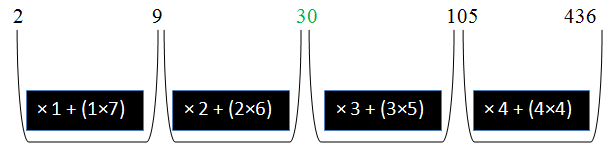
Q10.    2, 9,_______,105, 436, 2195
a) 25
b) 27
c) 30
d) 33 
e) None of The Above 
Solution
Option C

Number Series question no. #9

Number Series question no. #9
Number Series is easy as well as an important chapter. If you follow below mentioned tricks of this chapter, you can fetch marks from this chapter easily and quickly.

Q9.      33, 321, 465, 537, 573_______
a) 600
b) 591
c) 585
d) 498
e) None of The Above           
Solution
Option B 

Number Series question no. #8

Number Series question no. #8
Number Series is easy as well as an important chapter. If you follow below mentioned tricks of this chapter, you can fetch marks from this chapter easily and quickly.

Q8.        45, 46, 70, 141,_______, 1061.5
a) 353
b) 353.5
c) 352.5 
d) 352
e) None of The Above
Solution
Option B

#1 Question Analytical Reasoning

Find the number of triangles in the given figure?
A) 10B) 12
C) 14D) 16

 Answer & ExplanationAnswer: C) 14 

Explanation:
The figure may be labelled as shown
The simplest triangles are ABJ, ACJ, BDH, DHF, CIE and GIE i.e 6 in number.
The triangles composed of two components each are ABC, BDF, CEG, BHJ, JHK, JKI and CJI i.e 7 in number.
There is only one triangle JHI which is composed of four components.
Thus, there are 6 + 7 + 1 = 14 triangles in the given figure.